
Why E-Commerce Founders Choose UAE Free Zones
The UAE e-commerce market was valued at approximately USD 11 billion in 2024 and is on a trajectory toward USD 19 billion by 2029. That scale, combined with the country’s logistics infrastructure and its position between Asia, Europe, and Africa, makes the UAE one of the most strategic places to base an online business.
Free zones sit at the centre of that attraction. They offer 100% foreign ownership, zero personal income tax, full profit repatriation, and — depending on structure — exemption from UAE corporate tax on qualifying income. While mainland companies now also allow 100% foreign ownership for e-commerce under the 2021 Commercial Companies Law, free zones remain a top choice due to their dedicated digital infrastructure and distinct tax advantages. You retain full control of your shareholding from day one.
The trade-off is straightforward: free zone companies cannot sell directly to UAE mainland customers without a registered mainland distributor or a separate mainland entity. For pure cross-border e-commerce operations, that restriction is rarely a problem. For founders targeting both the UAE domestic market and international buyers, the structure requires more planning.
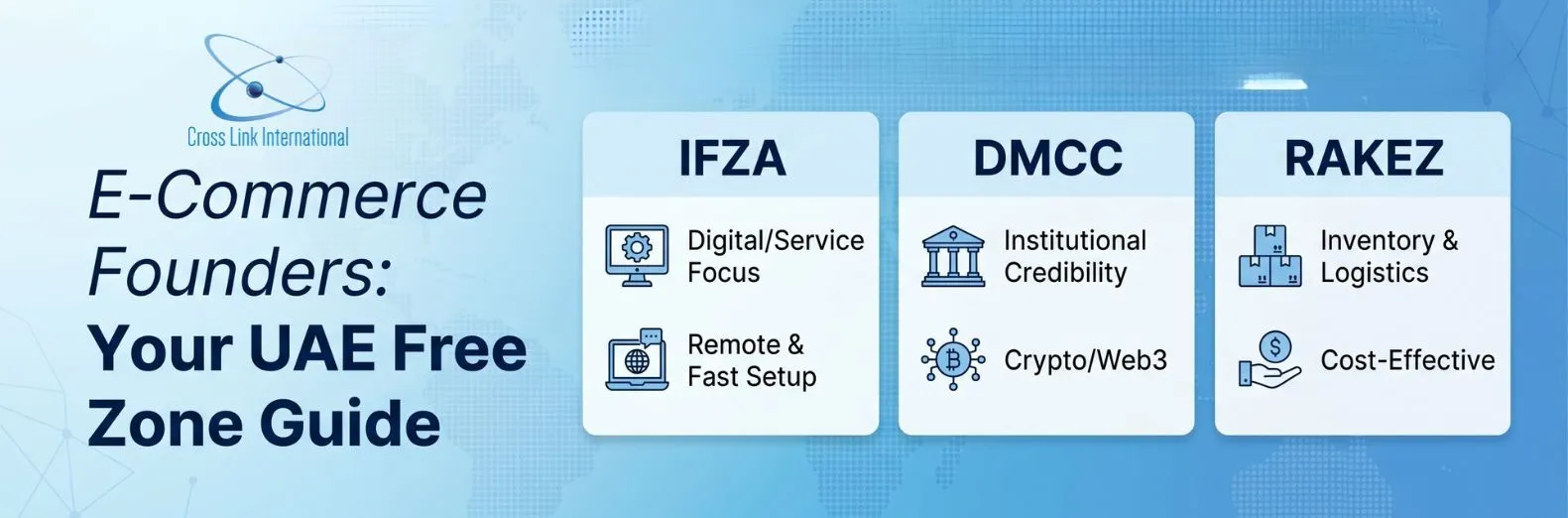
Three free zones dominate the conversation for e-commerce founders: IFZA, DMCC, and RAKEZ. Each addresses a different set of priorities. This guide lays out what each one offers, what it costs, and where each one falls short.
IFZA – International Free Zone Authority
Dubai Silicon Oasis, Dubai
IFZA relocated from Fujairah to Dubai Silicon Oasis in 2020. Since then it has licensed over 10,000 companies. Approximately 60% of those operate service-based or digital businesses, which reflects the zone’s appeal to consultants, agencies, and e-commerce brands that fulfil via third-party logistics rather than their own warehouse.
Costs and Packages
IFZA licence packages begin at AED 12,900 for a zero-visa option. A single investor visa package ranges from AED 14,900 to AED 21,900 depending on inclusions. Multi-year commitments can reduce the annual cost by up to 30%. The registration process completes in 3–5 working days, and the entire setup is available remotely — shareholders are not required to be physically present during incorporation.
What Works for E-Commerce
IFZA allows multiple business activities under a single licence. For an e-commerce operator running a trading operation alongside digital marketing or logistics coordination, that flexibility avoids the cost of registering separate licences. The zone’s digital-first setup process is a practical advantage for founders based outside the UAE during the initial formation stage.
The Dubai Silicon Oasis address carries genuine weight with UAE banks. While IFZA is newer than DMCC, most major local and international banks now process IFZA-registered companies without unusual friction, provided documentation is clean and the business narrative is clear.
Where IFZA Falls Short
IFZA does not offer dedicated warehousing or industrial facilities. Founders who need physical storage at the zone level will need to arrange logistics separately. The zone also lacks DMCC’s tier of brand recognition with international counterparties — for high-volume commodity trading or businesses that depend on institutional credibility from day one, that gap matters.
DMCC – Dubai Multi Commodities Centre
Jumeirah Lakes Towers, Dubai
DMCC has held the title of Global Free Zone of the Year from the Financial Times’ fDi Magazine nine consecutive times. The zone hosts over 26,000 registered companies across every major sector and contributes roughly 11% of Dubai’s annual foreign direct investment. For e-commerce brands that need institutional credibility, DMCC is the benchmark against which other zones are measured.
Costs and Packages
DMCC company formation starts at approximately AED 15,000 for basic licences. First-year totals — including registration fees, flexi-desk, and standard visa allocation — typically run between AED 30,000 and AED 60,000. The mandatory flexi-desk fee alone adds AED 6,500 or more annually, regardless of whether the space is used. Registration takes approximately 2–3 weeks.
What Works for E-Commerce
DMCC’s banking relationships rank among the strongest in the UAE. Emirates NBD, HSBC, and Standard Chartered actively onboard DMCC companies. For e-commerce businesses dependent on fast, reliable payment processing — particularly those handling high transaction volumes or international payment rails — that institutional trust shortens account opening timelines and reduces compliance friction.
DMCC also supports up to six activities on a single licence, more than most zones in this comparison. For e-commerce operators who also run consulting, marketing, or content arms, that breadth reduces structural complexity. The zone expanded its crypto, Web3, and AI licensing categories significantly in 2025, which widens the net for founders in those adjacent verticals.
Where DMCC Falls Short
Cost is the defining constraint. For a bootstrapped founder or an early-stage operator without confirmed revenue, the first-year investment required by DMCC is difficult to justify when IFZA or RAKEZ can provide functionally similar free zone status at a fraction of the outlay. Mandatory office fees apply even to virtual operations. Banking timelines have also lengthened to 6–8 weeks as compliance standards tighten.
RAKEZ – Ras Al Khaimah Economic Zone
Ras Al Khaimah (approx. 45 min from Dubai)
RAKEZ emerged from the 2017 merger of RAK Free Trade Zone and RAK Investment Authority. It now hosts over 30,000 companies from more than 100 countries and is one of the UAE’s largest economic zones by company count. Its core proposition is physical infrastructure at cost-effective pricing — warehousing, industrial land, logistics facilities, and direct links to seaports and airports.
Costs and Packages
RAKEZ has the lowest entry point of the three zones. E-commerce licence packages begin at AED 6,000, with starter packages including one visa available from AED 8,240. RAKEZ also runs a dedicated BusinessWomen programme offering 40% reduced fees for women entrepreneurs. Registration completes within 5–10 working days for most licence types, and remote setup is available.
What Works for E-Commerce
RAKEZ is the only zone in this comparison that offers a dedicated e-commerce licence alongside finished-product warehouse units designed specifically for order fulfilment and distribution. That combination is material for businesses that hold inventory. Warehouse access at RAKEZ plugs into direct routes to RAK Ports, national highways, and proximity to both Dubai and Sharjah, which keeps logistics costs manageable for businesses shipping across the UAE and the wider MENA region.
UAE residency visa holders must enter the UAE at least once every 180 days (6 months) to keep their visa active. Founders who manage operations remotely need to factor this requirement into their travel schedule, regardless of which free zone issued the visa. UAE residence visas are generally valid for 2 years. The Academic and Innovation Zone within RAKEZ also offers infrastructure relevant to tech-adjacent e-commerce businesses or founders building platforms.
Where RAKEZ Falls Short
The address is Ras Al Khaimah, not Dubai. For businesses where the Dubai brand on the company address carries commercial weight — particularly with international B2B clients or banking partners — that distinction can matter. Banking approval timelines at some institutions run longer for RAKEZ-registered companies than for DMCC or IFZA entities, and the zone’s distance from Dubai’s commercial centre adds a practical layer of coordination for founders with regular Dubai-based obligations.
Crosslink is a channel partner of IFZA and a registered agent of DMCC. We process your application directly — no third-party delays.
Side-by-Side Comparison
The table below uses public data from the respective free zone authorities. Actual costs vary with visa allocation, selected activities, and office type. Always request a total cost of ownership breakdown that includes year-two renewal fees, which often differ from year-one promotional rates.
| Factor | IFZA | DMCC | RAKEZ |
|---|---|---|---|
| Location | Dubai Silicon Oasis, Dubai | Jumeirah Lakes Towers, Dubai | Ras Al Khaimah (~45 min from Dubai) |
| Entry licence cost (approx.) | AED 12,900 – 21,900 | AED 30,000 – 60,000 (year 1) | AED 6,000 – 15,000 |
| Setup timeline | 3–5 working days | 2–3 weeks | 5–10 working days |
| Remote setup | Yes — fully remote | Partial — some in-person required | Yes — most licence types |
| Activities per licence | Multiple (2,000+ activity list) | Up to 6 (approx. 600 total) | Multiple — broad range |
| E-commerce licence | Yes | Yes | Yes — dedicated e-commerce licence |
| Warehousing / physical space | No in-zone warehousing | Premium offices; no warehousing | Yes — finished-product warehouses |
| Banking ease | Moderate – improving | Strong — highest in this comparison | Moderate — varies by institution |
| Bank account timeline | 2–4 weeks (average) | 6–8 weeks (compliance-heavy) | 3–6 weeks (varies) |
| Crypto / Web3 licence | Limited | Yes — expanded in 2025 | Limited |
| BusinessWomen discount | No | No | Yes — 40% reduced fees |
| Visa residency requirement | Enter UAE every 180 days (6 months) | Enter UAE every 180 days (6 months) | Enter UAE every 180 days (6 months) |
| Visa validity period | Generally 2 years | Generally 2 years | Generally 2 years |
| Best for | Digital e-commerce; Dubai address; lean startups | High-volume; institutional banking; B2B credibility | Inventory-based e-commerce; import-export; cost-first operators |
Banking and Payment Access
Every e-commerce business eventually runs into the same question: which banks will open accounts, and how long does it take? Free zone registration alone does not guarantee smooth banking. The zone you choose shapes that process significantly.
DMCC
DMCC carries the strongest institutional reputation of the three. Emirates NBD, HSBC, Mashreq, and Standard Chartered actively onboard DMCC entities. The zone’s compliance infrastructure and nine-consecutive-year Global Free Zone recognition give bank relationship managers confidence in the due diligence that has already been done at the registration stage. The trade-off is that approval timelines have extended as compliance scrutiny increases — 6–8 weeks is now a common estimate for first-time account opening.
IFZA
IFZA’s account opening process has become considerably smoother since 2020. The zone’s digital setup documentation is well-organised, which reduces back-and-forth with bank compliance teams. Founders who prepare a clear business narrative — what you sell, to whom, through which payment channels, and where revenue originates — typically complete the process in 2–4 weeks. IFZA’s Dubai Silicon Oasis address carries adequate weight with most mid-tier and large UAE banks.
RAKEZ
RAKEZ banking requires careful preparation. Some institutions are slower to process applications from Ras Al Khaimah-based entities, though this varies significantly by bank. Founders who work with a business setup consultant to match documentation to specific bank requirements reduce approval timelines materially. For e-commerce businesses that rely on third-party payment gateways (PayPal, Stripe, regional processors) alongside a UAE bank account, RAKEZ works — the account opening process simply requires more upfront preparation.
Regardless of which zone you choose: prepare your bank KYC package before your licence is issued. A clear business narrative, UBO chart, source of funds documentation, and evidence of trade activity (contracts, platform registration, website) compress timelines across all three zones.
Selling to the UAE Mainland
This question comes up in almost every e-commerce setup conversation. Can a free zone company sell to UAE customers?
The technical answer is: not directly. Free zone companies are licensed to operate within their zone and internationally. Trading directly with UAE mainland customers requires either a mainland distributor who imports goods on your behalf, or a separate mainland company structure that handles domestic sales.
In practice, many e-commerce businesses registered in UAE free zones sell to UAE consumers through platforms like Noon, Amazon.ae, or Namshi. Those platforms act as the intermediary — the consumer transacts with the platform, not directly with the free zone entity. That structure works for many pure product sellers. For businesses building their own direct-to-consumer website targeting UAE residents as the primary customer base, the mainland structure becomes a more relevant consideration.
Income generated from UAE mainland customers is taxable at the 9% UAE corporate tax rate under current legislation, regardless of free zone registration. Free zone income qualifies for 0% corporate tax only when it meets the qualifying income conditions under UAE tax law — which broadly means the income arises from transactions conducted within the free zone or internationally.
If your model depends significantly on UAE domestic sales, Crosslink advises discussing the dual-structure option — maintaining a free zone licence for international operations and a mainland trade licence for domestic activity — before committing to a single registration path.
Which Free Zone for Your Business Type
Choose IFZA if:
- You want a Dubai address at a competitive price
- Your operations are digital or service-based
- You fulfil through third-party logistics, not your own warehouse
- You need flexibility across multiple licence activities
- You are setting up fully remotely from outside the UAE
- Budget is a constraint but a Dubai jurisdiction is important
Choose DMCC if:
- You need the strongest possible banking relationships from day one
- You plan to raise external investment or work with international financial institutions
- Your e-commerce operates in commodity trading, crypto, or Web3
- Counterparty trust is crucial for business
- First-year costs are not the primary decision factor
- You want up to six activities on a single licence
Choose RAKEZ if:
- You hold or plan to hold physical inventory
- Your business involves import, export, or distribution
- Keeping first-year costs as low as possible is the priority
- You need in-zone warehouse or industrial space
- You are a woman entrepreneur (40% fee reduction)
- You operate remotely and can meet the 180-day visa entry requirement
Three-year cost planning matters more than first-year cost planning. A low entry price at RAKEZ that requires a mainland distributor arrangement to reach UAE customers may cost more over three years than an IFZA setup with a cleaner operational structure. Run the numbers for your specific model before committing.
Not Sure Which Free Zone Fits Your E-Commerce Model?
Crosslink International works across all UAE free zones. We compare options from 3–5 suitable jurisdictions based on your activity, visa needs, and three-year budget — not just what’s easiest to sell you.
Office 2011 & 2012, Metropolis Tower, Al Abraj Street, Business Bay, Dubai · info@crosslink.ae